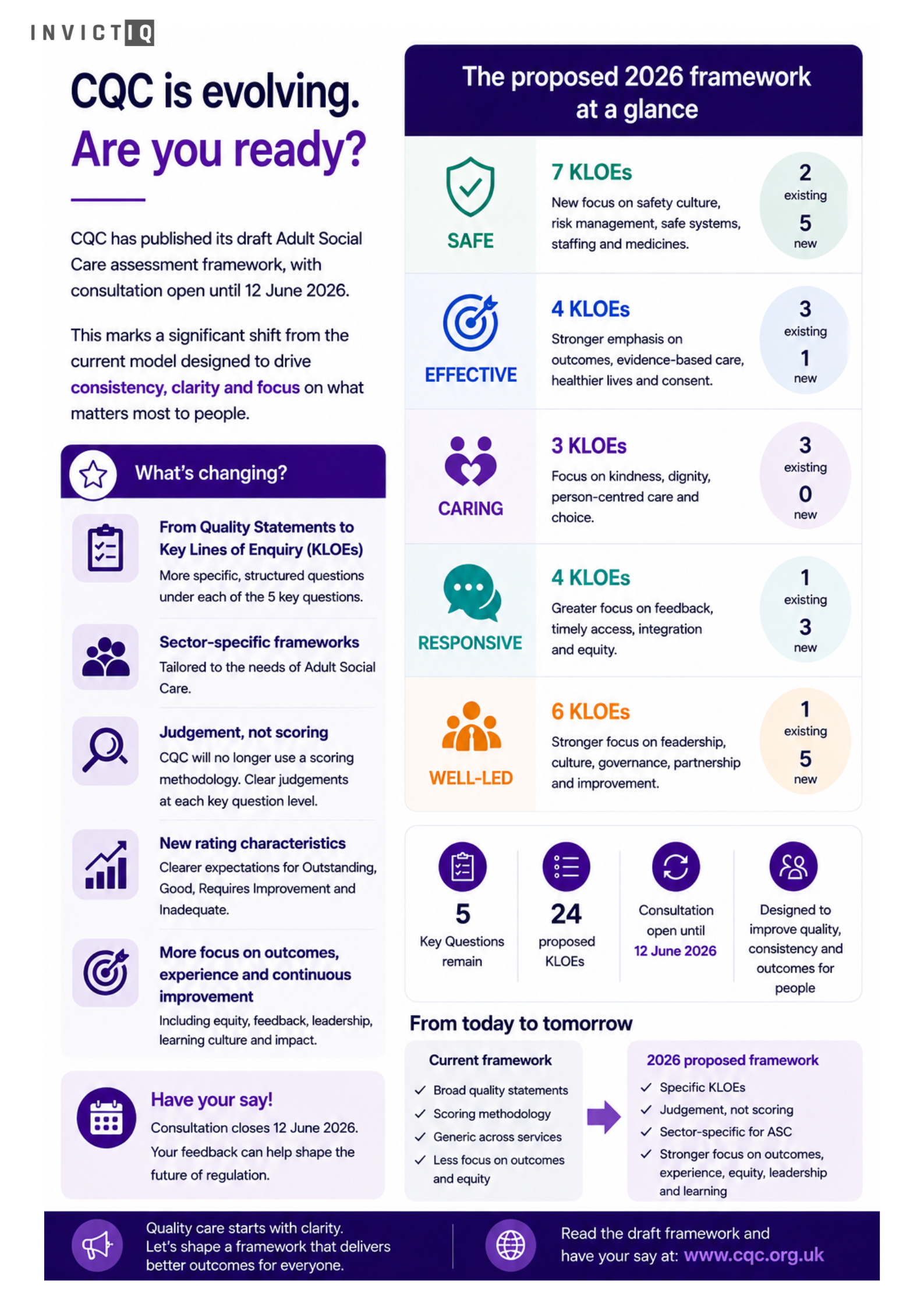

The Care Quality Commission has announced a major proposed shift in how it will regulate care. In its latest update, the CQC is proposing to move away from a single, generic framework for everyone. Instead, they are introducing separate, custom-made assessment systems for different sectors, starting with adult social care.
For care leaders, the biggest change might be the removal of the 34 “Quality Statements”. In their place, the CQC is planning to bring structured, investigative questions. Inspectors will use these specific questions to judge the service.
This update means Managers cannot rely on rigid compliance habits anymore. To keep the service running smoothly, the Head Office/Leadership Team will need a strategy for proactive quality management in care. This will ensure that the internal audits can adapt to these new framework without disrupting the everyday care routines.
What is Changing Under the New CQC Framework?
The CQC’s new sector-specific approach is designed to make inspections more relevant to how adult social care actually works. Here is what care provision owners need to know about the new design:
- Direct, Investigative Questions: Instead of general statements, inspectors will ask sharp questions. For example, they will ask exactly how the leadership team monitors safety risks and checks internal workflows.
- No More Numerical Scores: The CQC is completely removing numerical scores from its assessment methodology. Inspectors will now make direct judgements on the rating based on qualitative descriptions of “Good” and “Outstanding” care.
- Continuous Evidence Streams: The regulator is looking for continuous proof that the service is safe and well-led over a long period, not just on a single inspection day.
The Risk of Rigid Systems for International Teams
Many social care providers employ a diverse international workforce, where English may not be the first language for many staff members. When CQC assessment questions or frameworks change, organisations relying on static paper forms or spreadsheets often face a significant administrative burden updating templates manually across services.
This not only increases operational workload but can also create inconsistencies, confusion, and difficulties in ensuring teams clearly understand revised expectations and terminology.
When forms are long and complicated, busy care staff experience audit fatigue. They might miss important internal checks simply because the compliance sheets are too difficult to navigate. If your internal audits and checklists are not aligned with the CQC’s revised assessment structure and lines of enquiry, it can create significant gaps in oversight, evidence gathering, and inspection readiness.
How Agile Checking Solves the Problem
Transitioning to a dynamic checker tool like Audit on Cloud by InvictIQ ensures that regulatory shifts do not cause operational shocks. The platform acts as a smart quality engine that manages the changing rules in the background.
- Automatic Background Mapping: When the CQC updates its investigative questions, the platform aligns your existing audit templates to the new criteria automatically.
- Clear and Consistent Digital Audits: Structured digital audit templates reduce ambiguity, improve consistency across teams.
- Live Operational Visibility: Head Office can see exactly which safety loops are open or closed across all locations. If an audit highlights an error, the system automatically builds a clear action plan so the team can fix it quickly.
Protecting Your Rating with Proactive Quality Management in Care
With the CQC launching its new sector-specific testing, waiting for a formal assessment before updating your processes is too risky.
By adopting proactive quality management in care, you take the stress out of regulation. You change compliance from a confusing administrative chore into a simple, natural part of your daily routine.
Ultimately, the CQC’s move toward direct, qualitative questions proves that having robust internal checks is what matters most. When your governance system is agile, a change in regulatory policy becomes a simple background update rather than a major company crisis. You protect your managers’ professional standing, keep your files organized, and give your teams more time to focus on supporting service users.