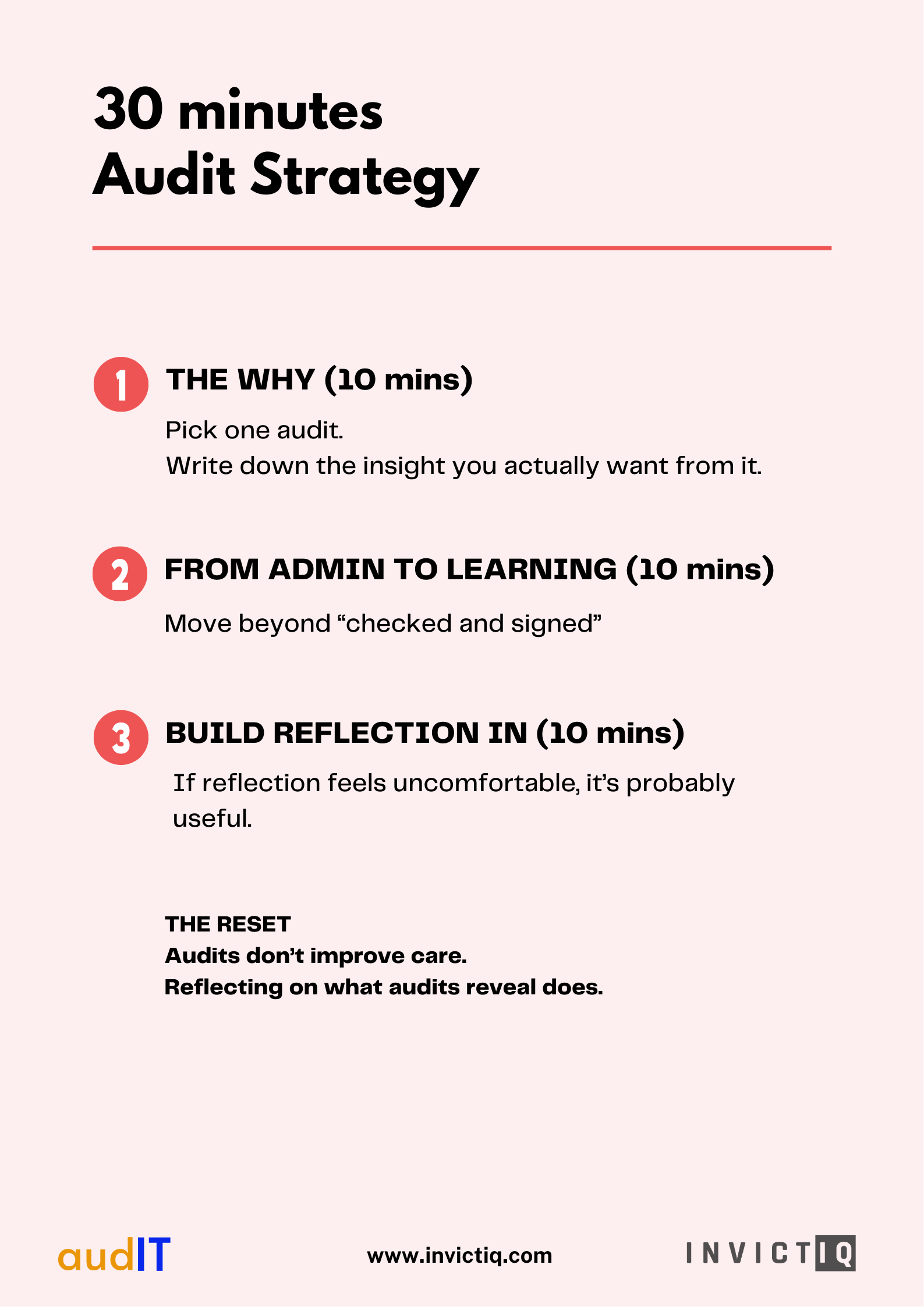

Let’s be honest, we all have lots of audits, and most of us will have a routine (weekly, monthly) but how many of us have a strategy? We are in a place of completing audits for audit’s sake, creating a checklist exercise and having that sense of relief when its off our to do list.
I often see in the manager groups a consistent theme coming up “we audit a lot, but I am not sure we are learning much”, so I thought I would take this blog, not to write about how to audit more, but how to use 30 minutes to define a strategy to reset, and it starts with one uncomfortable question ‘why are we auditing at all?’
Step One – The Why
There are three questions you need to ask yourself:
- What problem are we trying to prevent or understand?
- Who is the audit really for?
- What would better look and feel like?
In order to understand some of this, we have to look at the why and ask ourselves why we are auditing. Is it because:
- it is something we think should be in place
- because we have always done it
- we think CQC will expect us to have them
- you saw a service failed once and used it as a tool to prevent your service falling into the same trap or
- the system you use came with the audit, and you are just using it?
None of the reasons above are bad reasons, but none of them are learning focused. I do believe we are heading into the right direction in social care of us questioning why there are so many audits, what the point is and I do think if an audit doesn’t change a conversation or behaviour then it’s not really an audit, its just admin.
I want you to pick one audit. It could be your medication, falls, daily notes and write down what insight you actually want from it. When I did this, I found often it was compliance, and that should act as a warning sign.
Once you have your audit, and have reflected and wrote down the insight you want to get from it, you are ready to move onto step 2
Step 2 – Moving from admin to learning
I have alluded to this above, but most audits are conducted to produce proof that something has been checked, as opposed to using them to understand why things are going wrong and over time, why things keep going wrong and this is the difference between admin and learning and why you may feel like you audit a lot, but not learning as much. We need to generate insight and not just confirm compliance.
Ask yourself, how often are you checking an audit someone has completed, and you are checking the form is complete, it is signed off, the date is in the right place etc. We are purely looking at it from an administrative compliance point of view and we need to revamp the lens that we are reviewing it from. What we need to be asking ourselves from the data is:
- Why does this keep happening?
- What does this tell us about our systems, not our staff?
- What patterns are we ignoring because they are inconvenient or will cause us more work?
Your ten-minute task is to look at the last completed audit and ask:
- Did it lead to reflection, or just an action plan?
- Were actions set realistic, or just copied and pasted from previous audits?
- Did anyone explain why the issue existed?
If your action plan says staff were reminded to… or staff were retrained to… then you need to:
- Check those actions actually happened – are there records of conversations, did re-training take place
- Ask yourself:
- What about the rota
- What about time pressure
- What about unclear guidance
If your audit always finds that it is a staff problem, the audit is probably not telling you what it needs. Often the problem is caused by the staff but the root cause will be something else, and this is the purpose of the audit to find.
Step 3 – Building reflection into your audits
Reflection is often not thought about when it comes to auditing or is an after thought and with some audits, I have seen this as a box at the end for management comments for example. We are slowly seeing a shift towards micro-reflection and this is an easy shift to move towards.
Your final ten minute task is to look one audit, and add one reflective question which could be:
- What surprised me the most in this audit?
- What would I change about the system if I could?
- What would make this easier for staff to get right?
The idea is to have short, honest answers which aren’t used as judgement but for insight. I often think that if reflection is uncomfortable, it is probably useful. The final step is to then share this reflection with your team and how changes are being made to address this.
Hopefully at the end of this 30 minutes, you will be able to know whether you audit to learn or to tick a box, whether audits are really driving improvements in care and whether anything would change if this audit didn’t exist. We need to remember that audits do not improve care but reflecting on what audits reveal does.
Audit software like InvictIQ’s Audit on Cloud automates the collection and analysis of compliance data, making it easier for providers to monitor standards and respond to issues. Most have real-time dashboards, automated alerts and historical logs so that managers and providers can track everything and ensure nothing slips through the cracks.